Kleos Trusted Voices Index ranks the 20 top B2B voices on LinkedIn by trust Ocotber 2026
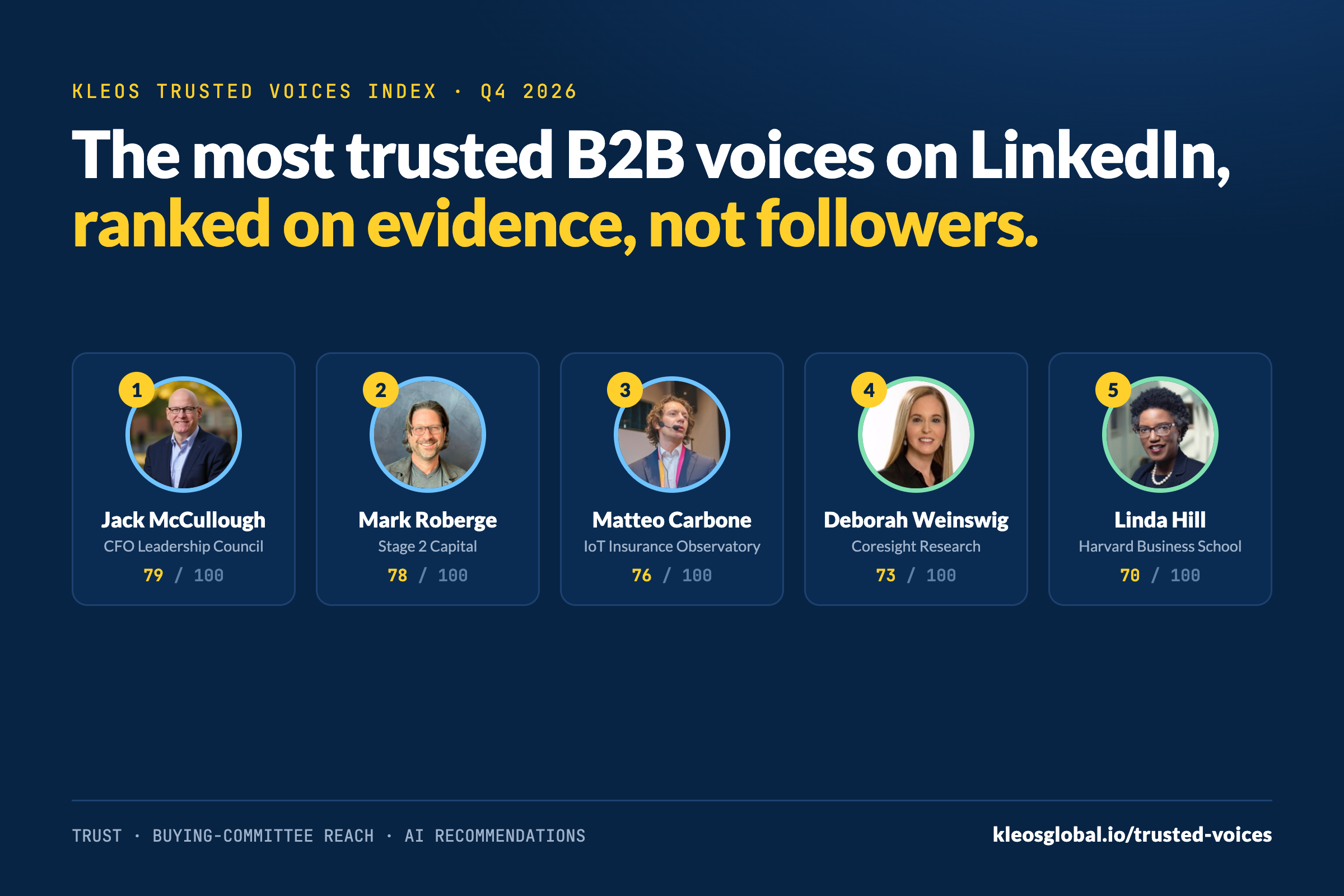
The most trusted B2B voices on LinkedIn, by the Kleos Trusted Voices Index (Q4 2026), are Jack McCullough (CFO Leadership Council), Mark Roberge (Stage 2 Capital), Matteo Carbone (IoT Insurance Observatory), Deborah Weinswig (Coresight Research) and Linda Hill (Harvard Business School). These top B2B influencers on LinkedIn are scored on TRUST, buying-committee reach and AI recommendations. Followers do not count.
*Q4 2026 edition. Data as of 16 October 2026.*
Key Takeaways:
- Jack McCullough of The CFO Leadership Council tops the Q4 2026 Kleos Trusted Voices Index, with an Index score of 79 and a TRUST score of 83.
- Deborah Weinswig of Coresight Research has the highest buying-committee share on the Index: 39% of the people engaging with her posts sit on a B2B buying committee.
- Only 1 of 7 well-known GTM names from the creator pool reached enough of the buying committee to make the Index.
- No voice in the top 20 reaches procurement leaders, even though Bain and LinkedIn research found hidden buyers hold about half the influence over a B2B purchase.
- The 20 voices split into 12 practitioners, 5 analysts and 3 creators.
Who are the top B2B influencers on LinkedIn by trust right now?
The top five are Jack McCullough, Mark Roberge, Matteo Carbone, Deborah Weinswig and Linda Hill.
TRUST is a 0 to 100 score for whether a buyer should believe a voice on their topic.
A buying committee is the group of people who shape and approve a B2B purchase.
The Index score, out of 100, combines TRUST, buying-committee reach and AI recommendations. "Buyers" is the share of each voice's engagers who hold a buying-committee seat.
1. Jack McCullough, The CFO Leadership Council (practitioner, CFO leadership)
2. Mark Roberge, Stage 2 Capital (practitioner, data-driven sales scaling)
3. Matteo Carbone, IoT Insurance Observatory (practitioner, IoT and InsurTech)
4. Deborah Weinswig, Coresight Research (analyst, retail technology)
5. Linda Hill, Harvard Business School (analyst, leading innovation)
6. Jacco van der Kooij, Winning by Design (practitioner, B2B SaaS revenue architecture)
7. Andrew Winston, Winston Eco-Strategies (practitioner, sustainable business strategy)
8. Peter Weinberg, Evidenza (practitioner, evidence-based B2B marketing)
9. Lisa Bodell, FutureThink (practitioner, simplification and innovation)
10. Sam Jacobs, Pavilion (practitioner)
11. Ted McKenna, Selling Innovations (analyst, B2B buyer indecision)
12. Glenn Hopper, RoboCFO (practitioner, AI in corporate finance)
13. Andrea Bonime-Blanc, GEC Risk Advisory (practitioner, AI governance and ethics)
14. Ben Murray, The SaaS CFO (practitioner, SaaS finance and metrics)
15. Phil Fersht, HFS Research (analyst, enterprise AI execution)
16. Benedict Evans, independent analyst (analyst, tech platform shifts)
17. CJ Gustafson, Mostly Media (creator, SaaS and startup finance)
18. Ross Dawson, Advanced Human Technologies Group (practitioner, AI in business strategy)
19. Kyle Poyar, Growth Unhinged (creator, SaaS pricing and packaging)
20. Shira Rubinoff, The Cybersphere Group (creator, cybersecurity and AI)
The lists AI engines cite for this question work differently. Other creator rankings says its is "based on reach and engagement", and its top spots go to tech founders and celebrities.
A CFO choosing a finance platform listens to someone like Jack McCullough, whose buyer engagers are 70% finance leaders.
What makes a B2B voice trustworthy?
A trustworthy B2B voice has years in the field, respect from others, deep knowledge, hands-on experience and honesty about the downsides. The Index scores those five things as TRUST, using public evidence only.
- Tenure. Years in the field and in the current role, from LinkedIn career history.
- Reputation. Half from their record (books, research, awards). Half from press, podcasts and speaking slots given by others in the last 12 months. Followers never count.
- Understanding of subject matter. Their last 10 to 15 posts: specific, original, explains why, stays on one field.
- Skin in the game. Did they run a function, a P&L or a company in the area they speak on? Consulting, analyst and academic roles score lower.
- Transparency. Do they talk about risks and failure cases, disclose sponsors and cite sources?
Mark Roberge has the highest TRUST He was the founding CRO of HubSpot. Lisa Bodell is next,
Trust is scarce in B2B right now. The Credibility Code whitepaper from Ipsos and LinkedIn's B2B Institute found "94% of B2B marketers agree that trust is critical to success" but "only 45% actually trust the vendors they engage with". A brand cannot close that gap by talking about itself.
Why don't follower counts tell you who B2B buyers trust?
Followers measure audience size. B2B deals are decided by a small group with specific jobs. So the Index counts who engages, after removing colleagues, vendors, students and job seekers.
The clearest proof came from a man whose company ranks creators by reach. Jeremy Boissinot, founder of Favikon, told me on the NotJustAds podcast: "there's plenty of people who got a lot of followers because they had the first mover advantage. And I'm talking about hundreds of thousands of followers on LinkedIn who essentially have zero reach today." LinkedIn, he said, is "probably the only social media platform where LinkedIn follower number is probably the less relevant."
The Index data points the same way. Kleos measured 7 well-known GTM names from the creator pool. Only 1 qualified: Sam Jacobs, CEO of Pavilion, listed as a practitioner at number 10.
Across 6,785 measured posts, reactions and buying-committee share moved slightly in opposite directions (r = -0.12). More reactions did not mean more buyers.
The average buying-committee share across every voice Kleos measured was 19.3%.
I managed $75M of LinkedIn ad spend for clients including HP, Expedia and Thomson Reuters. On LinkedIn's ad platform you build an audience by job function, seniority and company. That precision is why LinkedIn works for B2B. A voice's audience deserves the same check before a brand pays to reach it.
Ashlyn Remillard of Salesforce told me on NotJustAds that their creator choices are "all audience driven".
Our guide on why buying-committee overlap beats follower count walks through that check.
Which voices reach which seat on the buying committee?
Jack McCullough leads finance at 70%, Peter Weinberg leads sales and marketing at 65%, and nobody in the top 20 reaches procurement. HR has one voice in the top 20: Lisa Bodell, at 13%.
Procurement belongs to the hidden buyers. Hidden buyers are the procurement, finance, legal and operations people in the buying group that most marketing plans overlook.
Bain says "hidden buyers have half of the influence over that decision", and "around 90% of buyers purchase from their Day 1 list". LinkedIn's B2B Institute found hidden buyers "vetoed around HALF the vendors on the shortlist", and "more than 40% of B2B deals are abandoned before completion".
That LinkedIn page sources its abandonment research to *The JOLT Effect*, co-written by Ted McKenna, number 11 on the Index.
Each percentage is the share of that voice's buyer engagers who hold the seat.
- Chief executives and founders: Ross Dawson 49%, Jacco van der Kooij 45%, Ted McKenna 42%.
- Finance leaders: Jack McCullough 70%, CJ Gustafson 55%, Ben Murray 46%.
- Technology leaders: Phil Fersht 37%, Benedict Evans 30%, Shira Rubinoff 18%.
- Sales and marketing leaders: Peter Weinberg 65%, Sam Jacobs 48%, Kyle Poyar 42%.
- Risk and legal leaders: Shira Rubinoff 26%, Andrea Bonime-Blanc 19%, Lisa Bodell 6%.
- Operations leaders: Andrew Winston 13%, Lisa Bodell 10%, Matteo Carbone 7%.
- HR leaders: Lisa Bodell 13%.
- Procurement leaders: nobody on the list reaches this seat yet.
Procurement sits among the hidden buyers who vetoed half the shortlist in LinkedIn's research, and no trusted voice owns it.
Google searches on procurement topics are up 75% over the last 12 months, worldwide, according to the Index. That is open ground for brands and for voices.
Our piece on the Day 1 list and hidden buyers covers how to reach them early.
Which B2B experts do AI engines recommend, and do buyers follow them?
The Index asked Claude, Perplexity, Grok, Chat,GPPT and Google AI Overviews the questions a B2B buyer would ask, three times each. Peter Weinberg has the highest AI score on the list, at 96.
Linda Hill is next, at 90. AI recommendations and buyer trust do not always line up.
Mark Roberge is number 2 overall, with the top TRUST score. His AI score is 23, and only Claude named him.
Buyers now ask AI first. Devang Shah of LinkedIn told me on NotJustAds that 94% of B2B buyers use LLMs to make their decisions. Semrush found LinkedIn in about 11% of AI answers on average, and Profound ranks it the number one cited domain for professional queries. Who is trusted on LinkedIn shapes what AI tells your buyers.
The fastest-rising topic on the Index is AI search visibility (AEO and GEO), with Google searches up 145% over the last 12 months, worldwide, according to the Index. No trusted voice owns it yet. More on why B2B creator partnerships earn AI search citations.
Practitioner, analyst or creator: which kind of voice does your brand need?
If you need to prove your product works, pick a practitioner. That is most of the Index: 12 practitioners, 5 analysts and 3 creators.
- Practitioner. Has run the function, P&L or company they talk about. Jack McCullough, Mark Roberge and Matteo Carbone lead this group.
- Analyst. Studies the market and shapes how a category is understood. Deborah Weinswig, Linda Hill and Ted McKenna lead here.
- Creator. Content is their main business. CJ Gustafson, Kyle Poyar and Shira Rubinoff are on the list. Check the buying-committee share before paying for reach. All three pass: 55% of Gustafson's buyer engagers are in finance, 42% of Poyar's are in sales and marketing, and 26% of Rubinoff's are in risk and legal.
How was the Trusted Voices Index of top B2B influencers on LinkedIn built?
Kleos asked AI engines buyer questions, then checked each candidate's LinkedIn activity, audience and public record. To be listed, a voice had to pass four gates:
- Named by AI in 2 or more questions, or by 2 or more engines.
- 6 or more of their own LinkedIn posts in the last 90 days.
- A buying-committee share above the average, from 100 or more engagers.
- A TRUST score of 60 or more.
Kleos measured 350 voices for this edition. 49 passed all four gates, and the top 20 are listed.
Everyone who reacted or commented is classified by seniority, function and company. TRUST is averaged over 3 model runs, with a sample checked by hand. Only independent voices are listed. The Index never publishes who engaged with anyone's posts, partnership terms or low scores.
Full method notes are on the Index page.
How should a B2B brand work with a trusted voice?
Start with the seat you need to reach and pick the voice whose buyers hold it. Then agree a format: co-published research, an event, or their posts run as Thought Leader Ads. Thought Leader Ads are LinkedIn ads that run a real person's post, under their name, in front of an audience the brand picks.
The format performs. In the same Ipsos and B2B Institute whitepaper, creator Thought Leader Ads got "a 2.1x higher click-through rate than Single Image ads", and those with personal anecdotes "see a 31% engagement uplift".
Udi Ledergor of Gong told me on NotJustAds that for the Gong Engage launch he "partnered with over 20 sales and rev ops leaders for them to get behind our new product". Voices his buyers already listened to.
These voices do not work for you, so permission and contracts matter. Our guide to Thought Leader Ads with external creators covers both. If you are a voice reading this, start with what your authority is actually worth.
The 2.1x click-through rate comes from the format. The buyers come from the voice.
Frequently Asked Questions
Who are the top B2B influencers on LinkedIn in 2026?
By the Kleos Trusted Voices Index (Q4 2026), the top five are Jack McCullough, Mark Roberge, Matteo Carbone, Deborah Weinswig and Linda Hill. The Index ranks 20 voices on TRUST, buying-committee reach and AI recommendations. Followers are not counted, and the evidence for every score is on the Index page.
How do you find trusted LinkedIn voices in your industry?
Start with the buying-committee seat you need to reach, such as finance or risk. Then check who engages with each voice's posts and how many of them hold that seat. Look at their track record and earned media too. The Index does this for 20 voices across sales, finance, risk, retail and strategy.
Do follower counts matter for B2B influencers on LinkedIn?
Very little. Followers show audience size, and B2B deals are decided by a small committee. Favikon founder Jeremy Boissinot says LinkedIn is probably the platform where follower numbers matter least. On the Index, only 1 of 7 well-known GTM names from the creator pool reached enough buyers to qualify. Check who engages first.
What makes a LinkedIn creator trustworthy to B2B buyers?
The Index scores five things as TRUST: tenure in the field, reputation given by others, deep understanding of the subject, skin in the game from running the function, and transparency about risks and sponsors. Followers never count towards TRUST, because reputation has to come from other people.
Which B2B experts do ChatGPT and other AI engines recommend?
The Index tested Claude, Perplexity, Grok and Google AI Overviews, asking each buyer question three times. ChatGPT was not part of the test. Across those four engines, Peter Weinberg had the highest AI score at 96, then Linda Hill at 90. Some highly trusted voices, like Mark Roberge, were named by only one engine.
How do B2B brands work with LinkedIn voices?
The common formats are sponsored posts, co-published research, brand-hosted events and Thought Leader Ads. Thought Leader Ads run the voice's own post as a LinkedIn ad, aimed at an audience the brand picks. Creator Thought Leader Ads get a 2.1x higher click-through rate than Single Image ads (Ipsos and LinkedIn B2B Institute, 2026). Agree permission and a contract first.
How do you measure whether a LinkedIn voice reaches your buying committee?
Classify the people who react to and comment on their recent posts by seniority, function and company. Remove colleagues, vendors, students and job seekers. The share left who hold buying-committee seats is the number to watch. Deborah Weinswig leads the Index at 39%. Nobody in the top 20 reaches procurement yet.

Six years inside LinkedIn. $75M in ad spend managed. $700M in pipeline generated for HP, Expedia, Thomson Reuters and the London Stock Exchange. At Kleos, that operating knowledge is what every client gets specifically, how buying committees form preferences before the sales conversation starts. The same material I teach on the MBA programme at IE Business School.
Ready to reach your buying committee?
See how Kleos can help your brand become the most trusted voice in your market.
Work with Kleos